The History Of Horror
Since as
early as 1890, horror films have been a genre that has evoked many negative
emotional reactions from its audiences. The main features of these films often
included scenes that startled or frightened audience through the means of
macabre and the supernatural, and can sometimes overlap with fantasy and
supernatural genres. Horror overlaps most with the thriller genre.
Horror films deal with viewers
nightmares and hidden worse fears, revulsions and terror of the unknown. Although
a good deal of a film is about the supernatural, if it contains a plot about
morbidity, serial killers, a disease or virus out break and surrealism, then it
may be classed or termed as a horror movie.
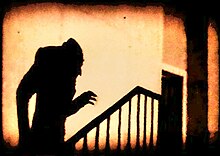
A famous scene from one of the first notable horror films Nosferatu (1922)
Plots that are written within the
horror genre often involve the intrusion of an evil force, event or personage,
commonly of supernatural origin, into the everyday world. Themes or elements
often prevalent in typical horror films include ghosts, torture, gore,
werewolves, ancient curses, Satanism, demons, vicious animals, vampires,
cannibals, hunted houses, zombies, sadism, and serial killers. However, stories
of the supernatural are not necessarily always a horror movies.
1890s-1920s
The first depictions of
supernatural events appear in several of the silent shorts created by the film
pioneer Georges Melies in the late 1890s, the best known being Le Manoir du diable (aka the Haunted Castle, 1896)
which is sometimes credited as being the first horror film. Another of his
horror projects was 1898's La
Caverne Maudite (The Cave
of the Unholy One, literally 'the accursed cave'). Japan made early forays
into the horror Genre with Bake
Jizo and Shinin no Sosei, both made in
1898. In 1910, Edison Studios produced the first film version of Frankenstein, which was thought
lost for many years.
In the early 20th century, the first monster appeared in a
horror film, Quasimodo, the hunchback of Notre-Dame who had appeared in Victor Hugo's novel, Notre-Dame de Paris (1831). Films featuring Quasimodo
included Alice Guy's Esmeralda (1906), The Hunchback (1909), The Love of a Hunchback (1910) and Notre-Dame de Paris (1911).
German Expressionist film makers, during the Weimar Republic era and slightly earlier, would
significantly influence later films, not only those in the horror genre. Paul Wegener's The Golem (1920) and Robert Wiene's The Cabinet of Dr. Caligari (also 1920) had a particular impact.
The first vampire-themed movie was made during this time: F. W. Murnau's Nosferatu (1922), an unauthorized adaptation of Bram Stoker's Dracula.
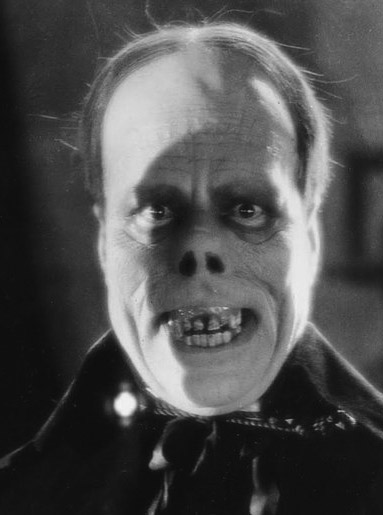
Lon Chaney Sr. in the Phantom Of the Opera
Hollywood dramas used horror themes, including
versions of The Hunchback of
Notre Dame (1923) and The Monster (1925) both starring Lon Chaney, the first American horror
movie star. Other films of the 1920s include Dr.
Jekyll And Mr Hyde (1920), The Phantom Carriage (Sweden, 1920), The Lost World (1925), The Phantom Of The Opera (1925), Waxworks (Germany 1924), and Tod Browning's (lost) London After Midnight (1927) with Chaney.
1930s-1940s
During the
early period of talking pictures, the American Movie studio Universal Pictures began a successful Gothic horror film series. Tod Browning's Dracula (1931), with Bela Lugosi, was quickly followed by James Whale's Frankenstein (also 1931). Some of these blended science fiction films with Gothic horror, such as The Invisible Man (1933) and, mirroring the earlier
German films, featured a mad
scientist. These films, while designed to thrill, also incorporated more
serious elements. Frankenstein was the first in a series which lasted
for many years, although Karloff only featured as the monster in Bride of Frankenstein (1935), again directed by Whale, and Son of Frankenstein (1939). The Mummy (1932) introduced Egyptology as a theme for the genre. Make-up artist Jack Pierce was responsible for the iconic image
of the monster, and others in the series. Universal's horror cycle continued
into the 1940s, these included The
Wolf Man (1941), not the
first werewolf film, but certainly the most
influential, as well as a number of films uniting several of their monsters.

Boris Karloff as Frankenstein's monster in Frankenstein's Bride
Other studios followed Universal's
lead. Tod Browning made the once controversial Freaks (1932) for MGM, based on "Spurs", a
short story by Ted Robbins, about a band of circus freaks. The studio disowned
the completed film after cutting about 30 minutes; it was unreleased in
the United Kingdom for thirty years. Rouben
Mamoulian's Dr. Jekyll and Mr.
Hyde (Paramount, 1931),
remembered for its use of colour filters to create Jekyll's transformation
before the camera, Michael Curtiz's Mystery
of the Wax Museum (Warner
Brothers, 1933), and Island of
Lost Souls (Paramount, 1933)
were all important horror films.
With the progression of the genre
actors were beginning to build entire careers in such films, most especially Boris Karloff and Bela
Lugosi. Karloff appeared in three of producer Val
Lewton's atmospheric B-pictures for RKO
Pictures in the mid-1940s,
including The Body Snatcher (1945), which also featured Lugosi.
The titles of these films were often imposed on Lewton by the studio, but Cat People (1942), I Walked with a Zombie (1943) rise above this limitation.
1950s-1960s
With advances in technology, the tone of horror
films shifted from the Gothic towards contemporary concerns. Two sub-genres
began to emerge: the horror-of-Armageddon film and the horror-of-the-demonic film.
A stream of usually low-budget productions featured
humanity overcoming threats from "outside": alien invasions and
deadly mutations to people, plants, and insects. In the case of some
horror films from Japan, such as Godzilla (1954) and its
sequels, mutation from the effects of nuclear radiation.
The Hollywood directors and producers
sometimes found ample opportunity for audience exploitation, with gimmicks such
as 3-D and "Percepto" (producer William Castle's
pseudo-electric-shock technique used for The Tingler, 1959). Some
horror films during this period, such as The Thing from Another World (1951)
and Don Siegel's Invasion of the Body Snatchers(1956), managed
to channel the paranoia of the Cold War into atmospheric
creepiness, .
Filmmakers continued to merge elements of science
fiction and horror over the following decades. A "pulp masterpiece” of the
era was The Incredible Shrinking Man (1957), from Richard
Matheson's existentialist novel. While more of a science-fiction
story, the film conveyed the fears of living in the Atomic Age and
the terror of social alienation.
During the later 1950s, Great Britain emerged as a
producer of horror films. Peeping Tom (1960), directed by Michael
Powell, concerns a serial killer who combines his profession as a photographer
with the moments before murdering his victims. The Hammer company
focused on the genre for the first time, enjoying huge international success
from films involving classic horror characters which were shown in colour for
the first time. Often starring Peter Cushing and Christopher Lee,
and drawing on Universal's precedent, these films include The Curse of
Frankenstein (1957), and Dracula (1958), both
followed by many sequels, with director Terence Fisher being
responsible for many of the best films. Other British companies contributed to
a boom in horror film production in the UK during the 1960s and 1970s,
including Tigon-British and Amicus, the latter best known for
their anthology films such as Dr. Terror's House of Horrors (1965).
British born director Alfred Hitchcock's Psycho (1960),
was the first "slasher" movie, while in the same director's The
Birds (1963) menace stems from nature gone mad. In France, Eyes
Without a Face (1960) continued the mad scientist theme, while in
Italy director Mario Bava began his own series of horror films.
American International Pictures (AIP)
made a series of Edgar Allan Poe–themed films directed by Roger
Corman and starring Vincent Price, which ended with The Masque of the Red Death and The Tomb of Ligeia (both 1964). Some contend that these
productions paved the way for more explicit violence in both horror and
mainstream films. In collaboration with AIP, Tigon produced Michael
Reeves' Witchfinder General (aka The Conqueror Worm, 1968). The tale of a witch hunter in the English Civil War, based on the historical Matthew Hopkins (Vincent
Price), was more sadistic than supernatural.
Ghosts and monsters still remained a
frequent feature of horror, but many films used the supernatural premise to
express the horror of the demonic. The Innocents (Jack
Clayton, 1961) based on the Henry James novel The Turn of the
Screw and The Haunting (Robert Wise, 1963) are two
such horror-of-the-demonic films from the early 1960s, both made in the UK by
American studios. In Rosemary's Baby (Roman Polanski, 1968),
set in New York, the devil is made flesh. Meanwhile, ghosts were a dominant
theme in Japanese horror, or 'J-horror', in such films as Kwaidan, Onibaba (both
1964) and Kuroneko (1968).
An influential American horror film of this period
was George A. Romero's Night of the Living Dead (1968).
Produced and directed by Romero, on a budget of $114,000, it grossed $12
million at the box office in the United States and $30 million internationally.
This horror-of-Armageddon film about zombies blends psychological
insights with gore, it moved the genre even further away from the gothic horror
trends of earlier eras and brought horror into everyday life.
Zombies in Romero's influential Night Of The Living Dead
Low-budget gore-shock films from the
likes of Herschell Gordon Lewis also appeared. Examples include Blood
Feast (1963), a devil-cult story, and Two Thousand
Maniacs! (1964), a ghost town inhabited by psychotic cannibals),
which featured splattering blood and body dismemberment.
1970s-1980s
The end of
the Production Code of America in 1964, the financial successes of
the low-budget gore films of the ensuing years, and the critical and popular
success of Rosemary's Baby,
led to the release of more films with occult themes in the 1970s. The Exorcist (1973), the first of these movies, was
a significant commercial success, and was followed by scores of horror films in
which the Devil represented the supernatural evil,
often by impregnating women or possessing children. The genre also included
gory horror movies with sexual overtones, made as "A-movies" (as
opposed to "B movies").
"Evil children" and reincarnation became popular subjects. Robert Wise's film Audrey Rose (1977) for example, deals with a man
who claims that his daughter is the reincarnation of another dead person. Alice, Sweet Alice (1977), is another Catholic-themed horror
slasher about a little girl's murder and her sister being the prime suspect.
Another popular Satanic horror movie was The
Omen (1976), where a man
realizes that his five-year-old adopted son is the Antichrist. Invincible to human
intervention, Satan became the villain in many horror films with a postmodern style and a dystopian worldview.
Another example is The Sentinel (1977 film), in which a fashion model
discovers that her new brownstone residence may actually be a portal to Hell. The movie includes seasoned
actors such as Ava Gardner, Burgess Meredith and Eli
Wallach and such future stars as Christopher Walken and Jeff
Goldblum.
The ideas of the 1960s began to
influence horror films, as the youth involved in the counterculture began exploring the medium. Wes Craven's The Hills Have Eyes (1977) and Tobe Hooper's The Texas Chain Saw Massacre (1974) recalled the Vietnam war; George A. Romero satirized the consumer society in his zombie sequel, Dawn of the Dead (1978); Canadian director David Cronenberg featured the "mad scientist"
movie sub-genre by exploring contemporary fears about technology and society,
and reinventing "body horror", starting with Shivers (1975).
Also in the 1970s, horror author Stephen King debuted on the film scene as many of
his books were adapted for the screen, beginning with Brian De Palma's adaptation of King's
first published novel, Carrie (1976), which was nominated for Academy Awards. Next, was his third
published novel, The Shining (1980), which was a sleeper at the box office, with mixed reviews,
but eventually began to be considered a classic. Carrie became the 9th highest-grossing film
of 1976. King himself did not like The
Shining, because it was barely faithful to the 1977 best-seller novel.
John Carpenter created Halloween (1978). Sean Cunningham made Friday the 13th (1980). Wes Craven directed A Nightmare On Elm Street (1984). This sub-genre would be mined
by dozens of increasingly violent movies throughout the subsequent decades, and Halloween became a successful independent film.
Other notable '70s slasher films include Bob Clark's Black Christmas (1974), which was released before Halloween, and was another
start of the sub-genre.
In 1975, Steven Spielberg began his ascension to fame with Jaws (1975). The film kicked off a wave of
killer animal stories such as Orca (1977), and Up from the Depths. Jaws is often credited as being one of the
first films to use traditionally B
movie elements such as horror and
mild gore in a big-budget Hollywood film.
Alien (1979) combined the naturalistic acting and graphic
violence of the 1970s with the monster movie plots of earlier decades, and used science fiction. The film was
extremely successful in terms of both box-office and critical reception, being
called "Jaws in
space", and a landmark film for the science
fiction genre.
On similar note, John Carpenter's The Thing (1982) was also a mix of horror and
sci fi, however unlike Alien it was neither a box-office nor
critical hit. However, nearly 20 years after its release it was praised for
using ahead-of-its-time special effects and paranoia.
Fright Night
The 1980s saw a wave of gory "B-Movie"
horror films - although most of them were panned by critics, many became cult classics and later saw success with critics. A
significant example is Sam Raimi's Evil Dead movies, which were low-budget
gorefests but had a very original plotline that was praised by critics later
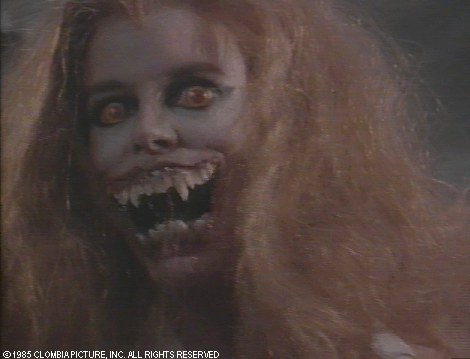
on. Other horror film examples include cult vampire classic Fright Night (1985) and The Lost Boys (1987).
1990s
In the
first half of the 1990s, the genre continued many of the themes from the 1980s.
Sequels from the Child's Play (1988) and Leprechaun (1993) series enjoyed some commercial
success. The slasher films A
Nightmare on Elm Street, Friday
the 13th, and Halloween all saw sequels in the 1990s, most of
which met with varied amounts of success at the box office, but all were panned
by fans and critics, with the exception of Wes Craven's New Nightmare (1994) and the hugely successful Silence of the Lambs (1991).
New Nightmare, with In
the Mouth of Madness (1995), The Dark Half (1993), and Candyman (1992), were part of a mini-movement
of self-reflexive or metafictional horror films. Each film touched upon
the relationship between fictional horror and real-world horror. Candyman, for example, examined
the link between an invented urban legend and the realistic horror of the
racism that produced its villain. In
the Mouth of Madness took a
more literal approach, as its protagonist actually hopped from the real world
into a novel created by the madman he was hired to track down. This reflective
style became more overt and ironic with the arrival of Scream (1996).
In Interview with the Vampire (1994), the "Theatre de
Vampires" (and the film itself, to some degree) invoked the Grand Guignol style, perhaps to further remove the
undead performers from humanity, morality and class. The horror movie soon
continued its search for new and effective frights. In 1985's novel The Vampire Lestat by author Anne Rice (who penned Interview...'s screenplay and the 1976 novel of the
same name) suggests that its antihero Lestat inspired and nurtured the Grand Guignol style and theatre.
Interview with the Vampire
Two main problems pushed horror
backward during this period: firstly, the horror genre wore itself out with the
proliferation of nonstop slasher and gore films in the eighties. Secondly, the
adolescent audience which feasted on the blood and morbidity of the previous
decade grew up, and the replacement audience for films of an imaginative nature
were being captured instead by the explosion of science-fiction and fantasy, courtesy of the special
effects possibilities with computer-generated
imagery.
To re-connect with its audience,
horror became more self-mockingly ironic and outright parodic, especially in the latter half
of the 1990s. Peter Jackson's Braindead (1992) (known as Dead Alive in the USA) took the splatter film to ridiculous excesses for comic
effect. Wes Craven's Scream (written by Kevin Williamson) movies, starting in
1996, featured teenagers who were fully aware of, and often made reference to,
the history of horror movies, and mixed ironic humour with the shocks. Along
with I Know What You Did Last
Summer (written by Kevin Williamson as well) and Urban Legend, they re-ignited
the dormant slasher film genre.
2000s
The start of the 2000s saw a quiet period for the genre. The
release of an extended version of The
Exorcist in September 2000
was successful despite the film having been available on home video for years.
Franchise films such as Freddy
vs. Jason also made a stand
in theatres. Final Destination (2000) marked a successful revival of
teen-centered horror and spawned five sequels. The Jeepers Creepers series was also successful. Films such
as Orphan, Wrong Turn, Cabin Fever, House of 1000 Corpses, and the
previous mentions helped bring the genre back to Restricted ratings in theatres.
Some
pronounced trends have marked horror films. A French horror film Brotherhood of the Wolf (2001) became the
second-highest-grossing French-language film in the United States in the last
two decades. The success of foreign language foreign films continued with the
Swedish films Marianne (2011) and Let the Right One In (2008), which was later the subject of
a Hollywood remake, Let Me In (2010). Another trend is the emergence
of psychology to scare audiences, rather than gore. The Others (2001) proved to be a successful example
of psychological horror film. A
minimalist approach which was equal parts Val Lewton's theory of "less is
more" (usually employing the low-budget techniques utilized on The Blair Witch Project, 1999)
has been evident, particularly in the emergence of Asian horror movies which
have been remade into successful Americanized versions, such as The Ring (2002), and The Grudge (2004). In March 2008, China banned
the movies from its market.
There has
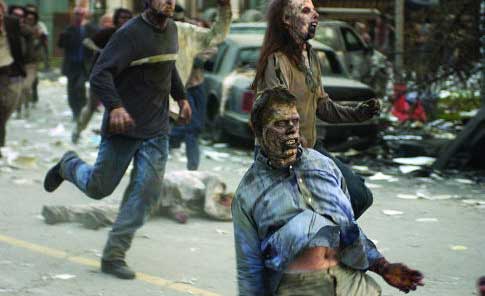
been a major return to the zombie genre in horror movies made after 2000. The Resident
Evil video game franchise was adapted into a film released
in March 2002. Three sequels have followed. The British film 28 Days Later (2002) featured an update on the genre
with The Return of the Living
Dead (1985) style of
aggressive zombie. The film later spawned a sequel: 28 Weeks Later. An updated remake of Dawn
of the Dead (2004) soon
appeared as well as the zombie
comedy Shaun of the Dead (2004). This resurgence led George A.
Romero to return to his Living Dead series with Land of the Dead (2005), Diary of the Dead (2007) and Survival of the Dead (2010).
 |
| Dawn of The Dead |
 |
| Shaun of the Dead |
A larger
trend is a return to the extreme, graphic violence that characterized much of
the type of low-budget, exploitation horror from the post-Vietnam years. Films
such as Audition (1999), Wrong Turn (2003), and the Australian film Wolf Creek (2005), took their cues from The Last House on the Left (1972), The Texas Chain Saw
Massacre(1974), and The Hills Have Eyes (1977). An extension of this trend was
the emergence of a type of horror with emphasis on depictions of torture,
suffering and violent deaths, (variously referred to as "horror
porn", "torture porn", Splatter porn, and even
"gore-nography") with films such as The
Collector, The Tortured, Saw, and Hostel, and their respective
sequels, frequently singled out as examples of emergence of this sub-genre. The Saw film series holds the Guinness World Record of the highest-grossing horror
franchise in history. Finally
with the arrival of Paranormal
Activity (2009), which was
well received by critics and an excellent reception at the box office, minimal
thought started by The Blair
Witch Project was reaffirmed
and is expected to be continued successfully in other low-budget productions.
Remakes of earlier horror movies became
routine in the 2000s. In addition to 2004's remake of Dawn of the Dead, as well as
2003's remake of both Herschell
Gordon Lewis' cult classic 2001 Maniacs and the remake of Tobe Hooper's classic The Texas Chainsaw Massacre,
there was also the 2007 Rob
Zombie written and directed remake of John Carpenter's Halloween. The film focused more on Michael's
backstory than the original did, devoting the first half of the film to
Michael's childhood. It was critically panned by most, but was a success in its theatrical
run, spurring its own sequel.
This film was among many remakes, or "reimaginings" of other popular
horror films and franchises with films such as Friday the 13th (2009), A Nightmare on Elm Street (2010), Children of the Corn (2009). The Amityville Horror (2005), The Hills Have Eyes (2006), Black Christmas (2006), Prom Night(2008), The Wicker Man (2006), My Bloody Valentine (2009), The Wolfman (2010), and House of Wax (2005).


.jpg/170px-Frankenstein's_monster_(Boris_Karloff).jpg)